26.4.11 | By: Deb

UBUD

View from my room.

View from the patio off my room.

Ubud is a fantastic little town right in the middle of Bali. I arrived at Denpasar Airport which is about an hour away at 18:30 from Singapore and had arranged with my guesthouse to get picked up at the airport. I am staying in a homestay here, it's about 5 minutes walk from the main street but right in the middle of the rice terraces so a great view. Ubud is surrounded on all sides by lush scenic rice fields, temples, little villages, rainforest and steep ravines plunging to the river below. You can walk through the rice fields on any of the paths out of town and see locals harvesting the rice and children playing. A few short minutes of walking and you are surrounded by nature. This will be my base city in Bali to do my sightseeing and tours from and I made the right choice, it's lovely here.
The path from town to my homestay.

Cafe's and houses with their great view of the river below.


Walking through the rise terraces.

View from my room.


Sunset, view from my room. Volcano in background.


Made, my homestay host, picked me up from the airport. We were both hungry so stopped for street food on the way home...BBQ goat satay skewers, rice soup ad deep fried bananas...all for $2.50! Delicious. His house has the best views out the back and is in the rice fields about a 5 minute walk from town...perfect location. Close enough to walk in but far enough to be in the middle of nature.


24.4.11 | By: Deb

KUCHING AND SINGAPORE

Kuching, the cat city, one of the many statues about town.
Kuching means ‘cat’ in Malay and the city is dedicated to them with statues all over, cats imprinted on the manhole covers, even a cat museum. Located along the bank of the Sungai Sarawak river,  the state capital Kuching is quite charming. It's a nice city and easy to get around. Although Kuching is a large city, the centre is pretty compact and isolated from the suburbs by the river so it feels small townish. Pretty parks and gardens along the river promenade have lots of walkways for strolling and good views of the mountains looming in the distance. Food stalls are everywhere, snacks everywhere, great restaurants and plenty of seafood...could become obese here.


Chinatown Arch


I spent 2 days in Kuching. I was planning on doing a day trip to Bako National Park on day 2 but was so exhausted from all the activity lately I took a day off my vacation and slept in instead, bummed around town, caught up on all things Internet in a cafe with free wifi and ate my body weight in seafood.

They have the most amazing food in Malaysia! There is this "food court" here on the roof of a parking garage...I know that sounds weird but it was spectacular. 10-12 different food stalls piled high with every kind of seafood you can imagine, live crabs swimming in buckets, huge fish with teeth larger than mine, tanks of barracuda's, shrimp the size of lobsters, even lobsters! It's kind of a mongolis grill type set-up. You get a plate from the stall you choose and pile it up with your seafood of choice, fill another plate with veggies and tell them how you want it cooked. I had a huge plate of massive shrimp butterflied and grilled with butter and garlic, mixed veggies and fried rice. Possible the best meal of my trip so far for about $8.00.
Food Court on the parking garage roof!

Tons of yummy veggies to go with the cornucopia of seafood.


Kuching waterfront.


Then I was off to Singapore... I only spent a day there as I've never been and it was cheaper to fly through Singapore on the low-cost airlines then go direct to Bali. Not too much to do in Singapore except shop and eat. I ate well here too. Very good street markets everywhere...also delicious food on the cheap everywhere you turn. Actually had really great Vietnamese foo for lunch today, really authentic tasting. Then headed to the airport and flew to Bali!
Singapore waterfront restaurants.

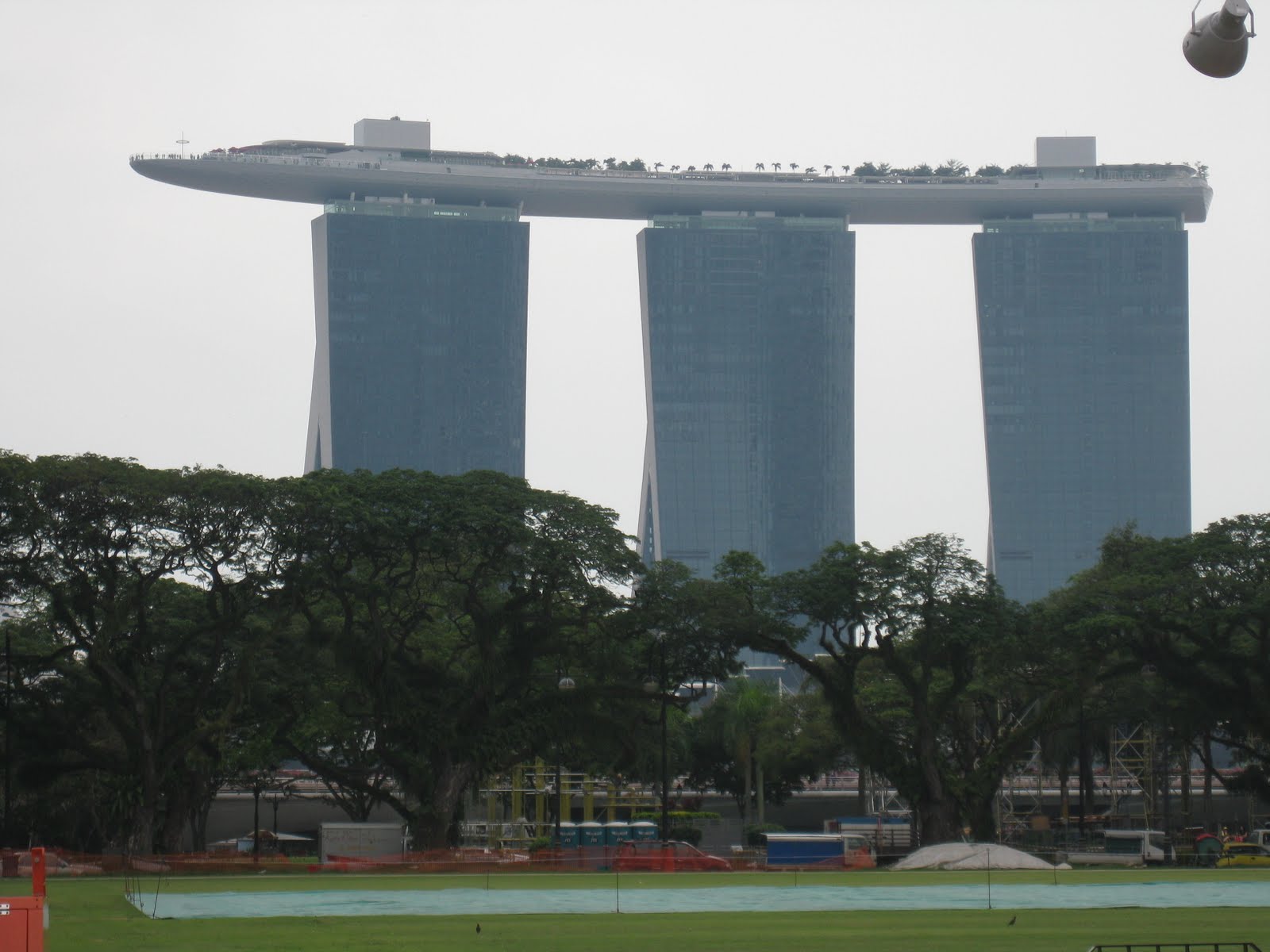
How cool is that building? Th marina bay sands: it has an infinity pool on top that looks down 55 stories! Wish I had the kind of money to experience that!!!


Chinatown....millions of people.

Cool Hindu temple.
23.4.11 | By: Deb

TRADITIONAL LONGHOUSE

The indigenous tribes of Sarawak gained worldwide notoriety as the fiercest headhunters on Borneo. Back in the old days, an Iban boy couldn't hope to marry a good woman without the shrunken head of an enemy to call his own, and bunches of  skulls still decorate the eaves of many jungle longhouses. Fortunately for me, headhunting hasn't been practiced for a while, although some of the skulls date from as late as World War II when, with British support, Iban mercenaries fought against the occupying Japanese.

According to Iban tradition, headhunting started as a religious rite several hundred years ago. At the turn of the 1800s, headhunting was rampant in Sarawak. It was considered “prestigious” to acquire heads in Iban society. The social status of a headhunter as a courageous man would be enhanced if he possessed heads, either taken by himself or acquired by other means.

The weapon used in headhunting is often the parang ilang — a heavy steel blade with a convex cutting edge, about 55cm long, mounted on a handle made from deer horn or belian (hardwood).
Heads were mainly taken in battle. Following any successful headhunting mission, the Ibans would hold a thanksgiving ritual.

Most of the heads taken by the Ibans were smoked in a manner similar to that in which fish is smoked. In this way, the head (minus the eyes) is preserved, together with the flesh and hair. Sometimes during the process the head is singed black.

It was not uncommon for some of the lesser warriors to sneak up and attack innocent women and children who were bathing at some isolated spot separated from the main tribe to collect their needed heads.

It was also a custom that heads had to be acquired after the death of a member of the family in order to appease the spirits. This custom goes back to the belief that Iban warriors must secure a head before the end of the burial ritual, failing which the burial would be incomplete and mourning would have to continue until a head was found.


After a head is taken it is given the greatest respect. The head, for months after its arrival, is treated with the greatest consideration, and all the terms of endearment… are abundantly lavished on it. The best food is thrust into its mouth and it is instructed to hate its former friends and that having been adopted into the tribe of its captors, its spirit must be always with them.

The tribal inhabitants of the Southeast Asian island of  Borneo lived traditionally in buildings known as a longhouse. Most of these are built raised off the ground on stilts and are divided into a more or less public area along one side and a row of private living quarters lined along the other side.
Livestock could shelter underneath the long houses for greater protection from predators and the elements.

In modern times many of the older longhouses have been replaced with buildings using more modern materials but of similar design.


The layout of a traditional longhouse is like this:
A wall runs along the length of the building approximately down the longitudinal axis of the building. The space along one side of the wall serves as a corridor running the length of the building while the other side is blocked from public view by the wall and serves as private areas.
Behind this wall lay the private units, each with a single door for each family. These are separated from each other by walls of their own and contain the living and sleeping spaces for each family. The kitchens may be situated within this private space but are quite often situated in rooms of their own, added to the back  or even in a building standing a little away from the longhouse and accessed by a small bridge. This separation prevents cooking fires from spreading to the living spaces, should they spread out of control, as well as reducing smoke and insects attracted to cooking from gathering in living quarters.


Lisa, my homestay host, grew up in a longhouse sharing a room and bed with her parents and 7 other siblings. People still live in longhouses in the villages but as times go by people have been moving out and building concrete houses and living in larger living spaces. Lisa's longhouse burned down from a cooking fire when she was 12 and after that she says most of the family's rebuilt elsewhere their own individual house.
You can still visit the longhouses here in various villages, Lars took us to one that wasn't very frequented by tourists in a small village.

They all have a central circular central house that they use for ceremonies. The one at the longhouse we went to still had skulls hanging from the ceiling. Lars said there were more and no one was quite sure what to do with them so they ended up beimg donated to the library after being passed around for some time between several homes.
22.4.11 | By: Deb

SEMENGGOK ORANGUTAN REHABILITATION SANCTUARY


On the last day of my time with Lars and Lisa we went to the Semonggok Wildlife Rehabilitation Centre, located south of Kuching. It is a sanctuary used to rehabilitate orangutans which have been injured or captured.

The rehabilitated animals roam freely in the rainforest, and often return to the centre at feeding time at 9am and 4pm where tourists can view whomever shows up on viewing platforms for an hour. They have had a successful breeding program at Semonggok and with several mom's and babies around and we were lucky enough to see one of them.

Since 1975 the center has been accepting animals either orphaned, injured, or rescued from captivity and reintroducing them back into the wild.

The Semenggoh Wildlife Rehabilitation Centre is not a zoo; unless quarantined, the animals are not kept in cages and are free to roam about the forest canopy. The primary goal of the wildlife center is to actually rehabilitate animals and get them back into the wild if at all possible.
The center offers a rare opportunity to view orangutans in a natural habitat; many orangutans in the refuge are considered semi-wild and rarely come back to the rehabilitation center.

Orangutan means "forest people" in the local language; the name fits their superior intelligence and human-like personalities. In 1996 a team of researchers witnessed a group of orangutans making sophisticated tools - and sharing them - for extracting seeds from fruit.
Orangutans are native only to Borneo and Sumatra and are considered extremely endangered. Of the estimated 61,000 orangutans existing in the wild, a little over 54,000 live on the island of Borneo. Female orangutans typically produce only one offspring every seven or eight years, hence the dwindling population.
Richie, the alpha male and dad to all the babies. Busy man!


Mom and baby eating pineapple.


Seduku - the "grandmother" at the Semenggoh Wildlife Rehabilitation Centre - was born in 1971 and has given birth to several offspring. Ritchie - the alpha male in the refuge - weighs over 300 pounds and was rescued by a journalist. Most of the orangutans at the center are named and the rangers can easily identify them with a glance. We were lucky to see Richie who is so huge and very hairy! He looks like a Sasquatch! They sleep in nests that they build fresh every night way up in the top of the trees...you can see them all over the place if you just look up.

VIDEOS OF THE ORANGUTANS BELOW:

RICHIE CLIMBING ACROSS THE ROPE WITH A MOUTHFUL OF BANANA'S

MOM AND HER BABY HANGING AROUND.

MAKING HIS ESCAPE WITH SOME SUGARCANE FROM ONE OF THE RANGERS.


This was an awesome experience! It was amazing to be so close to the orangutans.